In-House vs Outsourced Call Center in Dubai & UAE: Which Is Right for Your Business
For businesses operating in Dubai, Abu Dhabi, Sharjah, and across the UAE, delivering exceptional customer service is not just a competitive advantage — it’s a business necessity. The UAE’s dynamic economy, which spans sectors from retail and real estate to finance, hospitality, and e-commerce, demands responsive and high-quality customer support. One of the most strategic decisions a UAE business can make is whether to establish an in-house call center or outsource customer support operations to a specialist provider. According to Gartner, customer experience is now the primary competitive differentiator for businesses globally — making this decision more critical than ever for UAE enterprises. This guide from Arcnet UAE explores the pros, cons, and best-fit scenarios for each model.
In-House Call Centers in the UAE: Pros and Cons
An in-house call center means hiring, training, and managing your own customer support team within your Dubai, Abu Dhabi, or Sharjah office. This model is popular among large UAE enterprises, government-linked organizations, major banks in DIFC, and hospitality groups that require tight control over customer interactions and brand representation. The UAE’s robust free zone ecosystem — including Dubai Internet City, Abu Dhabi Global Market, and Sharjah Media City — provides businesses with the infrastructure to house in-house call center operations efficiently.
✅ Advantages of In-House Call Centers for UAE Businesses
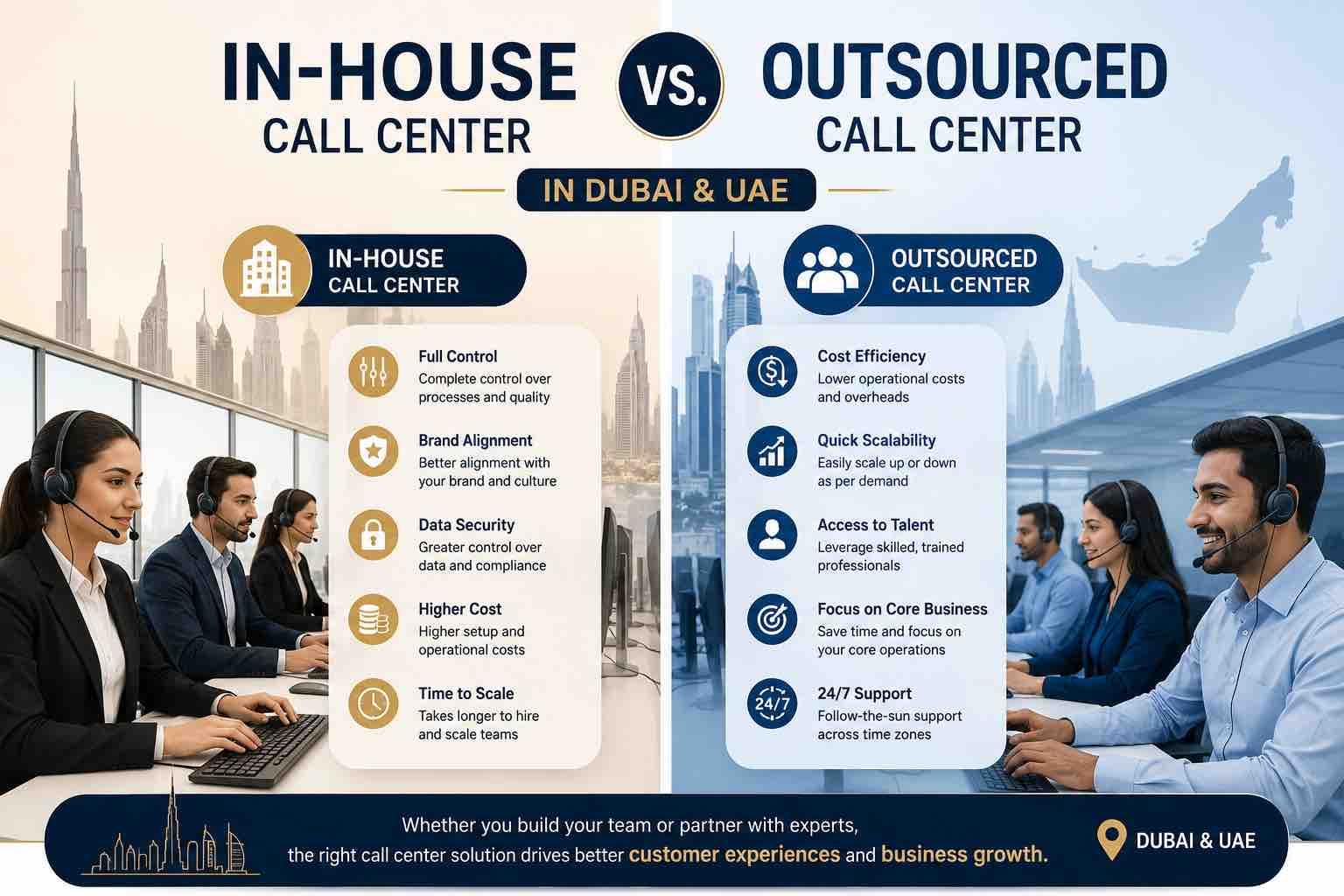
- ✅ Full Control & Brand Customization: In-house call centers give UAE businesses complete control over every aspect of customer interactions — from hiring bilingual Arabic and English-speaking agents to defining scripts, protocols, and escalation procedures that reflect your brand identity. This is particularly important for UAE businesses serving diverse, multicultural customers across nationalities.
- ✅ Seamless Internal Communication: In-house teams can collaborate directly with sales, operations, and technical departments within your Dubai or Abu Dhabi office, enabling faster issue resolution and more cohesive customer experiences. Integration with tools like Microsoft Teams or Salesforce CRM is seamless when teams share the same infrastructure.
- ✅ Stronger Data Security & UAE Compliance: Keeping customer data in-house gives UAE businesses greater control over compliance with the UAE Personal Data Protection Law (PDPL) and sector-specific regulations from bodies like the UAE Central Bank or Dubai Healthcare Authority (DHA). This is critical for financial institutions, healthcare providers, and government-related entities across the Emirates.
- ✅ Direct Customer Insights: In-house teams provide real-time, unfiltered access to customer feedback — invaluable for UAE product teams, marketing departments, and CX leaders looking to refine offerings for the local and GCC market.
❌ Disadvantages of In-House Call Centers in the UAE
- ❌ High Setup & Operational Costs: Establishing an in-house call center in Dubai or Abu Dhabi involves significant upfront and ongoing expenses — including office space in premium commercial districts, technology infrastructure, licensing fees, and competitive UAE salaries to attract qualified agents. Dubai’s commercial real estate costs make this especially relevant for growing SMEs.
- ❌ Resource-Intensive Management: Running a call center in the UAE demands continuous investment in staff training, technology upgrades, and HR management in a competitive labor market. UAE businesses must also navigate Emiratisation (Nafis) targets when building their customer service workforce, adding another layer of HR complexity.
- ❌ Scalability Challenges: Scaling an in-house team quickly to handle seasonal spikes — such as Ramadan shopping peaks, Dubai Shopping Festival, or year-end surges — can be slow and costly, often resulting in either overwhelmed agents or underutilized staff during quieter periods.
Outsourced Call Centers in the UAE: Pros and Cons
Outsourcing customer support to a specialist third-party provider is an increasingly popular strategy for UAE startups, e-commerce businesses, SMEs, and regional companies managing GCC-wide customer bases. The UAE’s position as a global business hub has attracted numerous international and regional Business Process Outsourcing (BPO) providers offering world-class call center services from locations including Dubai, Cairo, and Riyadh — enabling UAE businesses to access specialized customer service expertise without the overhead of an in-house operation.
✅ Advantages of Outsourced Call Centers for UAE Businesses
- ✅ Significant Cost Savings: Outsourcing customer support allows UAE businesses to convert large fixed costs into variable expenses. Deloitte’s Global Outsourcing Survey consistently shows that BPO reduces operational costs by 20–30% on average — highly relevant for Dubai SMEs and startups managing tight budgets in a high-cost operating environment.
- ✅ Access to Specialized Expertise: Leading BPO providers bring specialized training, multilingual capabilities (Arabic, English, Hindi, Urdu — essential for the UAE’s diverse population), and proven customer experience methodologies that can immediately elevate service quality without the long ramp-up time of building an in-house team.
- ✅ Rapid Scalability Across UAE Seasons: Outsourced providers can scale staffing up or down almost immediately — critical for UAE retail and e-commerce businesses managing volume spikes during Dubai Shopping Festival, Ramadan, White Friday, and National Day promotional periods.
- ✅ Focus on Core Business Activities: Outsourcing frees UAE leadership teams to concentrate on growth strategies, product innovation, and market expansion across the GCC — rather than managing day-to-day call center operations.
❌ Disadvantages of Outsourced Call Centers in the UAE
- ❌ Reduced Operational Control: Handing over customer interactions to a third party means accepting a degree of reduced oversight over service quality, agent behavior, and brand representation. For premium UAE brands in luxury retail, hospitality, or financial services, this trade-off requires careful management through robust SLAs and regular performance reviews.
- ❌ Potential Communication Gaps: Cultural and linguistic nuances matter deeply in the UAE’s multicultural market. Agents unfamiliar with Emirati culture, local business etiquette, or Arabic dialects may create friction in customer interactions — making provider selection and ongoing quality monitoring essential.
- ❌ Data Security & UAE Compliance Risks: Sharing customer data with a third-party provider introduces compliance risks under the UAE PDPL and sector regulators. UAE businesses must ensure their BPO contracts include stringent data protection clauses and that providers hold relevant ISO 27001 information security certifications.
In-House vs Outsourced Call Center: Quick Comparison for UAE Businesses
| Factor | In-House Call Center | Outsourced Call Center |
| Control | Full control over agents, brand & processes | Shared control via SLAs and contracts |
| Setup Cost | High — office, tech, recruitment in UAE | Low — no infrastructure investment needed |
| Ongoing Cost | Higher — salaries, training, tech upgrades | Lower — variable, pay-per-use models |
| Scalability | Slow — limited by UAE hiring timelines | Fast — scale up/down within days |
| Data Security | High internal control; easier UAE compliance | Requires robust data protection contracts |
| Multilingual Support | Requires local hiring (Arabic, English, etc.) | BPOs often provide multilingual teams |
| Best For UAE | Large enterprises, banks, government entities | SMEs, startups, e-commerce, seasonal businesses |
| Cultural Alignment | Full alignment with UAE brand values | Requires careful provider selection |
The Hybrid Model: The Best of Both Worlds for UAE Enterprises
Many successful UAE businesses — particularly large conglomerates, telecoms, and retail groups operating across the Emirates and GCC — are adopting a hybrid call center model. This approach maintains an in-house core team in Dubai or Abu Dhabi to handle complex, high-value, or sensitive customer interactions, while outsourcing high-volume, routine inquiries to a BPO partner. This model optimizes cost efficiency, maintains brand control on critical touchpoints, and provides the scalability needed to handle UAE’s seasonal demand fluctuations. According to McKinsey & Company, hybrid customer service models are increasingly the benchmark for world-class customer experience delivery — and UAE businesses are well-positioned to lead this trend in the region.
Arcnet UAE: Supporting Your Call Center Technology Infrastructure Across Dubai & the UAE
Whether you’re setting up an in-house call center in Dubai, upgrading your Abu Dhabi customer support infrastructure, or integrating outsourced BPO technology into your Sharjah operations, Arcnet UAE provides the end-to-end IT and networking infrastructure to power your customer service operations. Our services include structured cabling and network installation, VoIP and unified communications setup, cloud telephony solutions, data center connectivity, and cybersecurity infrastructure — all delivered by certified engineers across Dubai, Abu Dhabi, Sharjah, and the wider UAE. Contact Arcnet UAE today for a free consultation.